If you are looking for an RF anti-theft detector price in Tanzania, the cost depends on the number of entrances, the RF EAS equipment required, transport, installation, and the number of security tags needed. As a real Dar es Salaam example, MattyTech Global Inc. supplied and installed two RF anti-theft detector sets for Louis Feraud Paris at Dar Village Mall.
How much does an RF anti-theft detector cost in Tanzania?
There is no single price for every RF anti-theft installation because a complete EAS project can include detection gates, security tags or labels, deactivation equipment, transport, installation and commissioning. Tanzania’s EAS market is divided into components such as tags, antennas and detachers, so buyers should compare the cost of the complete solution rather than only the price of the antenna.
For a real Tanzania project, MattyTech Global Inc. purchased an RF anti-theft detector set from China for TSh 2,040,000 per set. After estimated international transport and associated costs, the estimated landed cost was approximately TSh 3.6 million per set.
This is a real project cost and should not be treated as a fixed nationwide retail price. Your final quotation can be different depending on the equipment specification, shipping, exchange rate, number of entrances, installation requirements and other project costs.
What is included in the price of an RF anti-theft detector?
An RF EAS installation normally involves more than the visible detection gates at the store entrance. EAS systems can include detection antennas, security tags or labels and equipment used to deactivate or remove tags when merchandise is legitimately purchased; Tanzania’s EAS market research identifies these components separately.
For a buyer in Tanzania, the important question is therefore not simply “How much is the RF detector?” but “How much will it cost to have my store protected and operational?”
A quotation should make clear whether it includes:
- RF detection gates
- RF security tags or labels
- Deactivator or detacher
- International transport
- Local delivery
- Installation
- Configuration and testing
- Warranty or after-sales support
A Tanzania installation example documented by Erico Group also shows an EAS project involving detection antennas, tags/labels and deactivation/detaching equipment. See the documented EAS installation in Tanzania.
How much does an RF anti-theft system cost for one store entrance?
The cost for one entrance depends on the width and configuration of the entrance and the type of detection coverage required. International EAS pricing guides also separate equipment, installation and other components when calculating the cost of a complete retail EAS project. See the EAS retail cost breakdown.
For example, a small fashion store with one entrance may have a different requirement from a large retail outlet with several independent entrances.
Do I need one RF detector or two detectors for one entrance?
An RF anti-theft system should be specified according to the required detection zone and entrance configuration rather than assuming that one physical antenna automatically represents a complete protected entrance. EAS installations use detection antennas as part of the overall system, and Tanzanian EAS project documentation illustrates the use of detection antennas as part of an installed system.
For this reason, when requesting a quotation, tell the installer how many entrances need protection and provide the approximate entrance width.
At Dar Village Mall, Louis Feraud Paris had two entrances requiring coverage, so MattyTech installed two RF anti-theft detector sets.
How much does RF anti-theft installation cost in Tanzania?
Installation is an additional cost when the equipment is imported or purchased separately. The final installation cost can depend on the number of systems, entrance configuration, electrical requirements, positioning, testing and commissioning.
For the Louis Feraud Paris project at Dar Village Mall, MattyTech Global Inc. charged:
- One RF detector set installation: TSh 400,000
- Two RF detector sets installation: TSh 680,000
The two-set installation was therefore not simply calculated as TSh 400,000 × 2, reflecting the project quotation for installing both systems.
Professional installation is important because EAS performance depends on correct installation and system configuration. Research into consumer responses to EAS alarms also demonstrates why alarm behaviour matters in a retail environment, making proper installation and management important for the customer experience. Journal of Retailing research on consumer responses to EAS alarms.
What is the total cost of an RF EAS system for a retail shop?
The total project cost should be calculated from the equipment cost, international transport, installation and any other components or services required. Comparing only the factory purchase price can produce an unrealistic budget because imported equipment has additional landed and installation costs.
RF Anti-Theft Detector Cost Example — Tanzania
| Cost item | One set | Two sets |
|---|---|---|
| Purchase price in China | TSh 2,040,000 | TSh 4,080,000 |
| Weight | 36 kg | 72 kg |
| Transport rate | USD 15/kg | USD 15/kg |
| Estimated transport cost | Approx. TSh 1.4 million | Approx. TSh 2.8 million |
| Estimated landed cost | Approx. TSh 3.6 million/set | Approx. TSh 7.2 million |
| Installation | TSh 400,000* | TSh 680,000 |
| Project example | — | Approx. TSh 7.88 million |
*The one-set installation price is the quoted MattyTech installation charge. The two-set project used the specific TSh 680,000 installation charge.
Important: The TSh 3.6 million figure is the estimated landed cost supplied from the actual project information. The purchase price plus the stated estimated transport alone is approximately TSh 3.44 million, so the difference should not be interpreted as transport alone; it represents the broader estimated cost of bringing the set into Tanzania.
This entire table is based on MattyTech Global Inc.’s actual procurement and installation experience.
How does an RF anti-theft detector work?
An RF Electronic Article Surveillance system uses a security tag or label attached to merchandise and detection equipment positioned at the store exit. When an active compatible tag enters the detection field, the system can trigger an alarm to alert staff.
RF EAS commonly uses 8.2 MHz technology, and research from the University of Exeter describes the use of 8.2 MHz EAS labels for electronic article surveillance. University of Exeter’s research on EAS tags.
The important distinction is that an EAS system is primarily a theft-detection system, not an inventory-identification system. It is designed to help retailers detect protected merchandise passing through the detection zone.
CCTv camera installation service
What is the difference between RF and AM anti-theft systems?
RF and AM are different Electronic Article Surveillance technologies, and the appropriate choice depends on the merchandise, environment, required detection characteristics and installation conditions. EAS technical information explains the differences between RF and other EAS technologies.
RF systems commonly operate around 8.2 MHz, while AM systems use a different technology and frequency range. The University of Exeter’s EAS research provides additional technical context for RF EAS labels.
For a Tanzanian business owner, the better question is not simply “Which one is cheaper?” but “Which EAS technology is appropriate for my products and store?”
Which businesses in Tanzania should use an RF anti-theft detector?
RF anti-theft systems can be relevant to businesses selling merchandise that needs protection against unauthorized removal, including fashion stores, supermarkets, retail outlets and other stores. Tanzania EAS market research specifically identifies segments including fashion stores, supermarkets and drug/health-product stores. See the Tanzania EAS market segmentation.
Potential users include:
- Fashion and clothing stores
- Supermarkets
- Pharmacies and drug stores
- Electronics shops
- Bookstores
- Department stores
- Shopping malls
- Other retail stores selling theft-sensitive merchandise
EAS should be considered as one component of a broader loss-prevention strategy rather than as a standalone guarantee against theft. Independent retail crime-prevention research evaluates retail tagging as a measure that can contribute to reducing shop theft. College of Policing’s retail tagging evidence.
Is an RF anti-theft detector suitable for a fashion shop?
Yes, fashion retailers are a common application for EAS because individual merchandise can be protected with compatible security tags or labels. Tanzania market research identifies fashion stores among the country’s EAS end-user segments. See the Tanzania EAS market analysis.
The store should select tags that are appropriate for the merchandise and ensure that the detection system is correctly installed around the relevant exits.
Is an RF anti-theft detector suitable for a supermarket?
EAS can be considered for supermarkets as part of a broader loss-prevention system, particularly for selected merchandise rather than necessarily every product in the store. Supermarkets are specifically identified among Tanzania’s EAS market segments. 6Wresearch’s Tanzania EAS market research.
The practical implementation depends on which products are being protected, how they are packaged and how customers move through the store.
Can pharmacies use RF anti-theft detectors?
Pharmacies and drug/health-product stores are among the EAS end-user segments identified in Tanzania. Tanzania EAS market research identifies drug and health-product stores as part of the market.
However, product packaging and materials should be considered when selecting the appropriate EAS technology and tag.
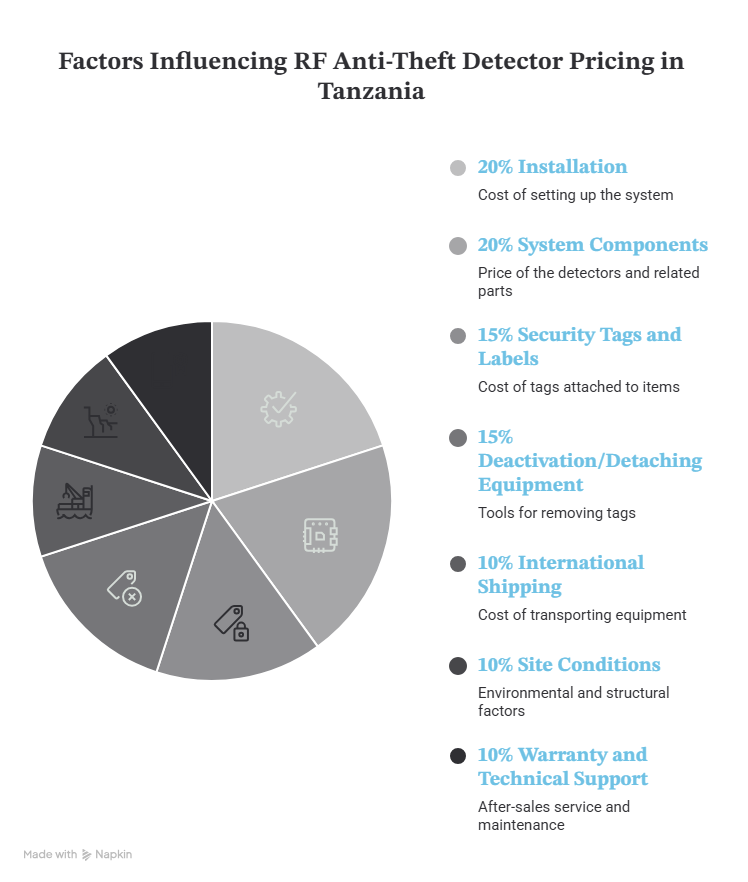
What affects the price of an RF anti-theft detector in Tanzania?
The biggest mistake when comparing EAS quotations is assuming that the detector’s factory price is the final installed price. International EAS cost guides also identify installation and system components as factors in the overall project cost. EAS installation cost factors.
The main factors include:
- Number of entrances — more entrances generally mean more protected detection points.
- Entrance width and layout — the physical configuration affects the required detection arrangement.
- RF detector specification — different equipment has different capabilities and configurations.
- Security tags and labels — the required quantity depends on the volume of merchandise being protected.
- Deactivation/detaching equipment — required for legitimate sales depending on the tag system.
- International shipping — imported equipment incurs freight costs.
- Installation — professional installation adds labour and commissioning costs.
- Site conditions — electrical and physical installation requirements can affect the project.
- Warranty and technical support — after-sales service should be considered when comparing quotations.
MattyTech’s China purchase, 36 kg/set weight and USD 15/kg transport rate provide the real-world Tanzania import example here.
How many RF anti-theft detectors does a store need?
The number of RF anti-theft detector sets required depends primarily on the entrances that need protection and the configuration of those entrances. A store with one entrance has a different requirement from a store with two separate customer entrances.
At Dar Village Mall, Louis Feraud Paris had two entrances requiring protection, so MattyTech Global Inc. supplied and installed two RF anti-theft detector sets.
The project is a useful example of why a business should provide the installer with its actual store layout before receiving a final quotation.
Louis Feraud Paris, Dar Village Mall — two entrances, two RF detector sets.
Security Systems Installation in Dar es Salaam
Are cheap RF anti-theft detectors worth buying?
The lowest equipment price does not necessarily represent the lowest total cost for a retail business. A buyer should consider equipment compatibility, detection requirements, installation quality, suitable tags, support and the complete landed cost.
EAS technology also has practical limitations depending on the materials and application. University of Exeter’s research on EAS tags discusses limitations associated with particular merchandise materials.
For an imported system, ask for the complete installed quotation rather than comparing the China purchase price, supplier price or online marketplace price alone.
Can RF anti-theft systems reduce retail theft?
EAS can form part of a retailer’s loss-prevention strategy by providing an alert when protected merchandise passes through a detection point without the tag having been appropriately deactivated or removed. Independent evidence from the College of Policing evaluates retail tagging as a crime-prevention measure rather than treating it as a guaranteed solution to every form of shop theft. College of Policing evidence on retail tagging.
The system works best as part of a broader security strategy that can include staff procedures, CCTV, access control and other loss-prevention measures.
CCTV Camera Installation in Dar es salaam
Why do RF anti-theft detectors sometimes cause false alarms?
EAS alarms are influenced by the system, tags, merchandise, environment and how the system is configured and operated. Research into consumer responses to EAS alarms has examined how these alarms can affect the customer experience, which is one reason reliable installation and proper system management matter. Research published in the Journal of Retailing examined consumer responses to EAS alarms.
A professional installation should therefore include appropriate positioning, configuration and testing before the system is handed over to the customer.
What should I check before buying an RF anti-theft detector in Tanzania?
Before accepting an RF EAS quotation, ask the installer to specify the complete project rather than giving you only a hardware price.
Check:
- How many entrances need protection?
- What is the approximate width of each entrance?
- How many RF detector sets are required?
- Are security tags or labels included?
- Is a deactivator/detacher included?
- Does the price include installation?
- Does it include testing and commissioning?
- What is the international transport cost?
- What warranty is provided?
- Is technical support available in Tanzania?
- What is the total installed price in Tanzanian shillings?
This approach makes it easier to compare quotations from different suppliers on an equivalent basis.
Electric fence Installation in Tanzania
Frequently Asked Questions About RF Anti-Theft Detectors in Tanzania
How much is an RF anti-theft detector in Tanzania?
As a real MattyTech Global Inc. procurement example, an RF detector set cost TSh 2,040,000 in China, while its estimated landed cost in Tanzania was approximately TSh 3.6 million per set after estimated transport and associated costs. The final selling price can vary according to equipment specification, shipping, installation and project requirements.
How many RF anti-theft detectors do I need for my shop?
The required number depends mainly on the entrances that need protection and the required detection coverage. For example, MattyTech installed two RF detector sets for Louis Feraud Paris at Dar Village Mall because the store had two entrances requiring coverage.
What is the difference between RF and AM anti-theft systems?
RF and AM are different EAS technologies with different technical characteristics and applications. The appropriate choice should depend on the merchandise, store environment and required detection performance rather than price alone. Technical information on EAS technologies.
Does the RF anti-theft detector come with security tags?
That depends on the quotation and package supplied by the installer. Security tags/labels are separate EAS components, so a buyer should confirm whether the required quantity of tags is included in the quoted price. Tanzania EAS market research identifies tags, antennas and detachers as separate EAS components.
Final takeaway
For businesses in Dar es Salaam and elsewhere in Tanzania, the most useful way to compare RF anti-theft detector prices is to calculate the complete installed project cost rather than looking only at the equipment’s factory price.
The Louis Feraud Paris project at Dar Village Mall demonstrates this clearly: MattyTech Global Inc. installed two RF anti-theft detector sets for two store entrances, with an estimated landed equipment cost of approximately TSh 3.6 million per set and a total installation charge of TSh 680,000 for the two sets.
If your store has one or more entrances that need protection, the appropriate system should be determined from the actual store layout, merchandise and required detection coverage.